Lung Capacity: The Overlooked Predictor of Health and Long Life

Most people think of heart health as the benchmark for overall wellness. However, research spanning more than four decades consistently points to a different marker — one most people never think to measure. Your lung capacity turns out to be one of the most reliable predictors of how long you will live. Specifically, it measures how much air you can move in and out of your lungs, and how well you will function as you age.
The good news is that lung capacity responds to what you do. Breathing habits, exercise, and posture all influence it in measurable ways. The research on how to protect it is more practical than most people expect.
What Lung Capacity Actually Measures
Lung capacity refers to the total volume of air your lungs can hold and exchange. Clinicians typically measure it using a spirometry test, which records two key values. The first is forced vital capacity (FVC) — the total volume of air you can exhale after a full breath in. The second is forced expiratory volume in one second (FEV1) — how much of that volume you can push out in a single second.
These numbers matter because they reflect how efficiently your respiratory system delivers oxygen to your blood. When lung capacity is compromised, less oxygen reaches your cells per breath. As a result, your body has to work harder to compensate.
The Research: Why Lung Capacity Predicts Longevity
The connection between lung capacity and lifespan has been documented across multiple large, long-term studies.
The earliest and most cited comes from the Framingham Heart Study. In 1983, researchers William B. Kannel, Helen Hubert, and Edward A. Lew analyzed vital capacity data from thousands of participants. They concluded that lung function was a significant independent predictor of cardiovascular disease and mortality — one that held up even after controlling for smoking, age, and cholesterol.1 That was the study that first put lung capacity on the map as a longevity marker.
Subsequent research has reinforced and extended those findings. A nearly 30-year follow-up study from the University at Buffalo, published in the journal Chest, found that lower FEV1 scores correlated with significantly higher risk of death across the entire follow-up period. Importantly, the increased risk was not confined to people with severely impaired lung function. Even moderately reduced capacity raised mortality risk in both smokers and lifelong non-smokers. The researchers concluded that the lung functions as a primary defense organ against environmental toxins.4 Consequently, impaired lung function reduces that protection across the board.
More recently, a 2026 study from Cambridge University Hospitals and Imperial College London analyzed data from 5,628 patients. Researchers found that reduced total lung capacity was independently associated with increased risk of cardiovascular disease and heart attack, even after accounting for other cardiometabolic risk factors.2 Furthermore, research from the EPIC-Norfolk cohort found that every meaningful decline in FEV1 corresponded to a 28–35% increase in cardiovascular mortality risk.3 That figure illustrates how meaningful even modest changes in lung function can be.
In practical terms: better-functioning lungs mean more oxygen delivered to your heart, brain, and muscles with each breath. Over years and decades, that efficiency compounds into measurable differences in health and lifespan.
Why Lung Capacity Declines — and How Fast
Lung capacity peaks in your mid-to-late twenties and then begins a slow, steady decline. By age 50, many people have lost roughly 40 to 50 percent of the capacity they had in their youth. Several factors drive this:
Age-related changes. The elastic tissue in the lungs stiffens gradually over time, reducing their ability to fully expand and recoil. The respiratory muscles — particularly the diaphragm — weaken if not regularly challenged.
Shallow breathing habits. Most adults use only a fraction of their available lung volume in daily life. Chest breathing relies primarily on the upper chest muscles rather than the diaphragm. As a result, the lower lobes of the lungs are consistently underventilated.
Sedentary behavior. Without regular aerobic demand, the respiratory muscles receive little training stimulus. Research published in PLOS One found that aerobic fitness is positively associated with FEV1 and FVC across all ages. It also found that improvements in fitness during younger decades are associated with greater adult lung volumes.5
Poor posture. A hunched or forward-rounded posture physically compresses the thoracic cavity, limiting how fully the diaphragm can descend on each inhale.
Air quality. Chronic exposure to pollutants, particulates, and indoor air contaminants accelerates functional decline in lung tissue.
What Reduced Lung Capacity Costs You Day to Day
The body is good at masking a gradual loss of lung capacity, often for years. However, over months and years, reduced lung capacity tends to produce a recognizable pattern:
Shortness of breath appears earlier during physical activity. Energy levels fall because cells receive less oxygen for metabolic processes. Stamina and endurance decrease, making exercise feel harder than it should. Concentration and mental clarity can suffer, since the brain is among the most oxygen-hungry organs in the body. General recovery — from exertion, illness, or stress — takes longer.
For many people, these changes arrive gradually enough that they attribute them to simply getting older. In fact, they reflect a specific and addressable decline in respiratory function.
How to Protect and Improve Your Lung Capacity
The research points clearly to three practical areas: breathing technique, aerobic exercise, and posture. None of these requires special equipment or clinical supervision for a healthy adult.
Breathing Technique: Diaphragmatic Breathing
The diaphragm is the large dome-shaped muscle at the base of the lungs. It is designed to do most of the work of breathing — approximately 80 percent, according to the American Lung Association. However, most adults have defaulted to chest breathing, which instead recruits the smaller muscles of the neck, upper chest, and shoulders. This pattern leaves the lower lobes of the lungs chronically underventilated.
Diaphragmatic breathing, also called belly breathing or abdominal breathing, corrects this by re-engaging the diaphragm as the primary breathing muscle. When the diaphragm contracts fully on the inhale, it descends downward. This creates a larger pressure drop in the thoracic cavity, drawing air into the base of the lungs where the greatest density of capillaries for gas exchange is located.
Research supports this. A study published in PubMed found that diaphragmatic breathing was associated with significant increases in tidal volume (the amount of air per breath) and higher oxygen saturation. It also reduced breathing rate — meaning more oxygen per breath with less respiratory effort.6 A separate study on controlled diaphragmatic breathing in hypoxic conditions found that it significantly increased both arterial and muscle oxygen saturation, compared to free uncontrolled breathing.7
How to practice diaphragmatic breathing:
Sit or lie down in a comfortable position. Place one hand on your chest and the other on your abdomen, just below the ribcage. Take a slow, steady breath in through your nose. As you inhale, your abdomen should rise, while your chest stays relatively still. This confirms the diaphragm is doing the work. Exhale slowly through your mouth, and notice the abdomen fall. Aim to exhale for roughly twice as long as you inhaled.
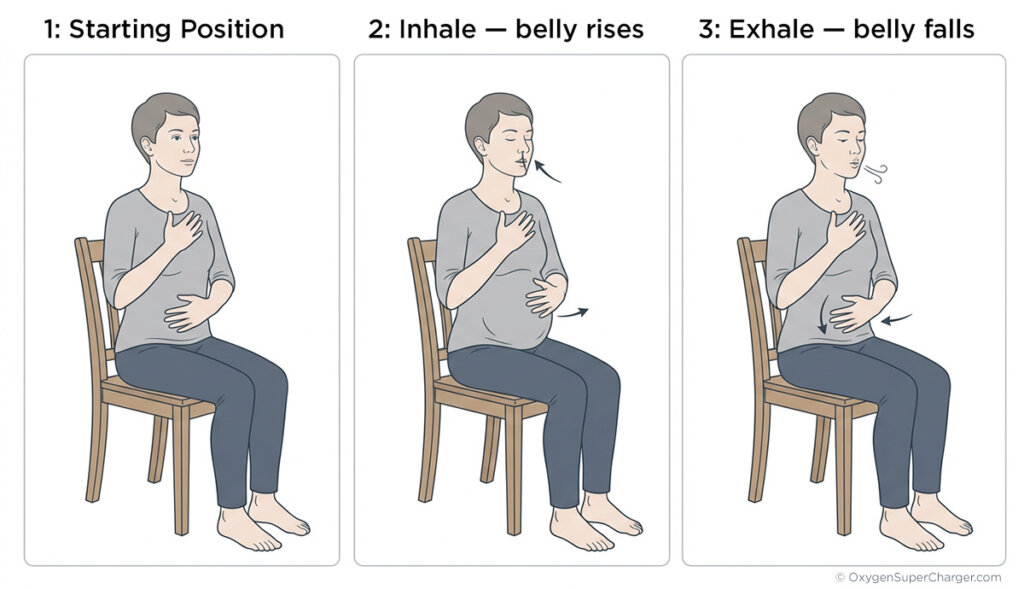
Practice this for five to ten minutes, twice daily. Most people notice it feels unfamiliar at first — that is normal, because chest breathing has become automatic. With two to three weeks of daily practice, diaphragmatic breathing begins to feel natural.
Pursed-Lip Breathing
Pursed-lip breathing is a complementary technique that slows the exhale and keeps the airways open longer. It also improves gas exchange by preventing the small airways from collapsing prematurely. NIH’s StatPearls reference describes it as a simple yet clinically effective technique. It notes documented use in pulmonary rehabilitation programs.8
How to practice pursed-lip breathing:
Inhale slowly through your nose for two counts. Then purse your lips as if you are about to blow gently on hot food. Exhale slowly through pursed lips for four counts — twice as long as the inhale. This extended, controlled exhale helps flush stale air from the lungs more completely. In turn, it makes room for a fuller, fresher inhale on the next breath.
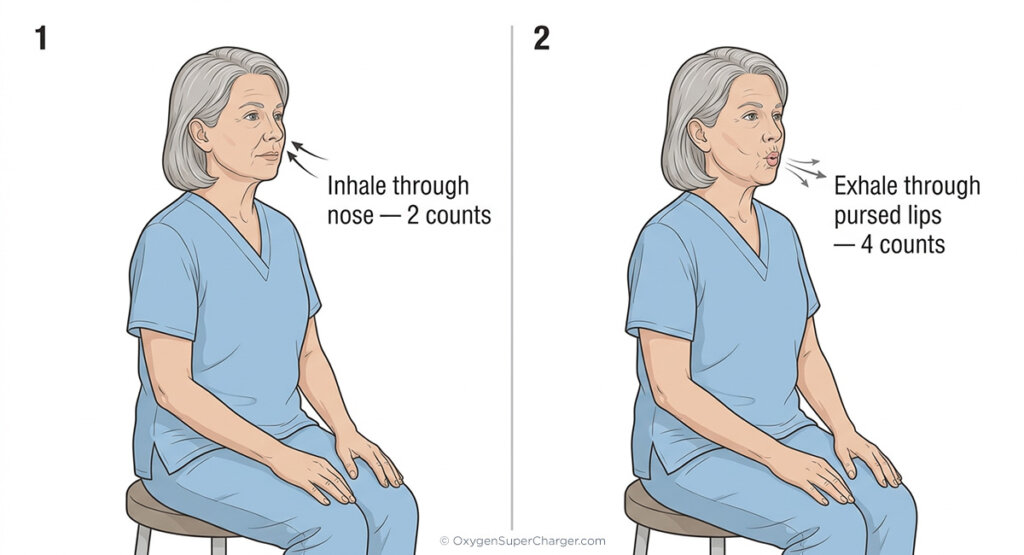
Pursed-lip breathing is particularly useful during or after physical exertion, or any time you notice yourself breathing faster than you would like.
Aerobic Exercise
Aerobic exercise places a sustained demand on the respiratory system. Over time, it strengthens respiratory muscles and improves the efficiency of gas exchange. This is one of the most well-supported interventions for maintaining lung function.
A case-control study of 292 young adults found significant improvement in FEV1 after 8 weeks of daily aerobic exercise compared with inactive controls.9 A systematic review and meta-analysis of 22 trials confirmed that regular aerobic exercise improved FEV1, forced vital capacity, and peak expiratory flow across multiple study designs.10 Additionally, a longitudinal study following thousands of participants across two countries found that aerobic fitness is positively associated with FEV1 and FVC at every age studied. The strongest lifetime benefits were seen when fitness was improved during younger decades (the Odense Study, Denmark; the Dunedin Multidisciplinary Health and Development Study, New Zealand).5

Walking, cycling, swimming, and sustained aerobic activities lasting 20 to 30 minutes are among the most practical options. The key is consistency — the benefits accumulate over weeks and months of regular activity, not from occasional intense sessions.
Posture
Poor posture mechanically limits lung capacity. When the thoracic spine rounds forward and the shoulders collapse inward, the ribcage cannot expand fully. The diaphragm also cannot descend to its full range.
Research confirms this is not a minor issue. A 2024 systematic review found that forward head posture — the common pattern where the head drifts forward of the shoulders — was associated with measurable reductions in both FVC and FEV1 across multiple studies. Specifically, FVC reductions ranged from 0.25 to 0.81 liters, and FEV1 reductions ranged from 0.16 to 0.93 liters.11 A cross-sectional study of healthy computer workers aged 25–35 found that 83.8% had measurable forward head posture. It was significantly associated with reduced FVC, FEV1, and peak expiratory flow.12 In other words, the posture most people adopt when looking at a screen all day has a real and measurable effect on how much air the lungs can move.
Two simple techniques address this directly.
Chin tucks. Sit or stand tall. Without tilting your head up or down, gently draw your chin straight back, as if making a slight double chin. Hold for three to five seconds, then release. This resets the head over the shoulders rather than in front of them. It reduces the mechanical compression on the thoracic cavity. Repeat ten times throughout the day — particularly if you spend extended time at a desk or on a screen.
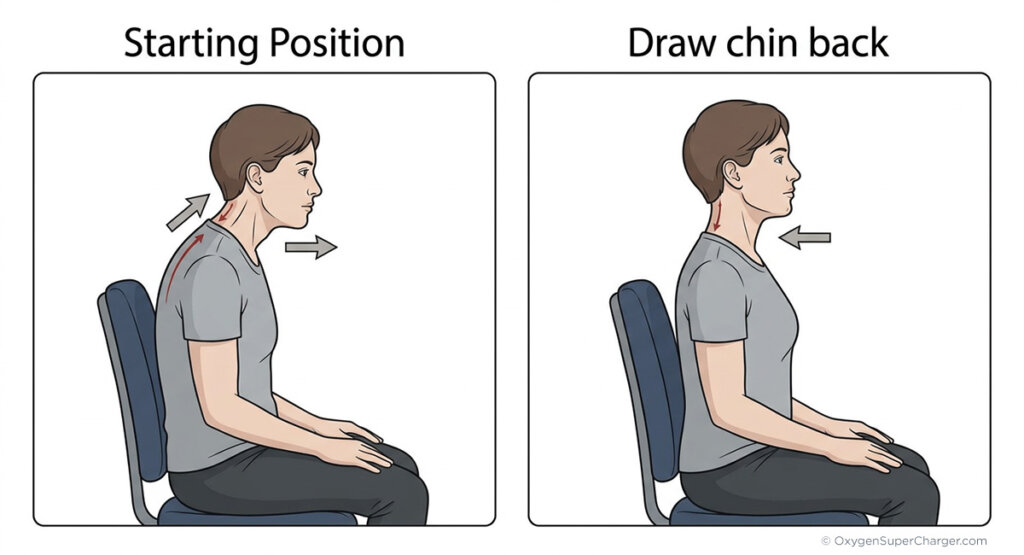
Thoracic extension stretch. Sit in a chair with a firm back. Place your hands behind your head. Gently arch your upper back over the top edge of the chair back, opening the chest toward the ceiling. Hold for three to five seconds and return to an upright position. This counteracts the forward rounding of the thoracic spine that accumulates with prolonged sitting. It also helps restore the rib cage’s full range of motion. Repeat five to ten times.
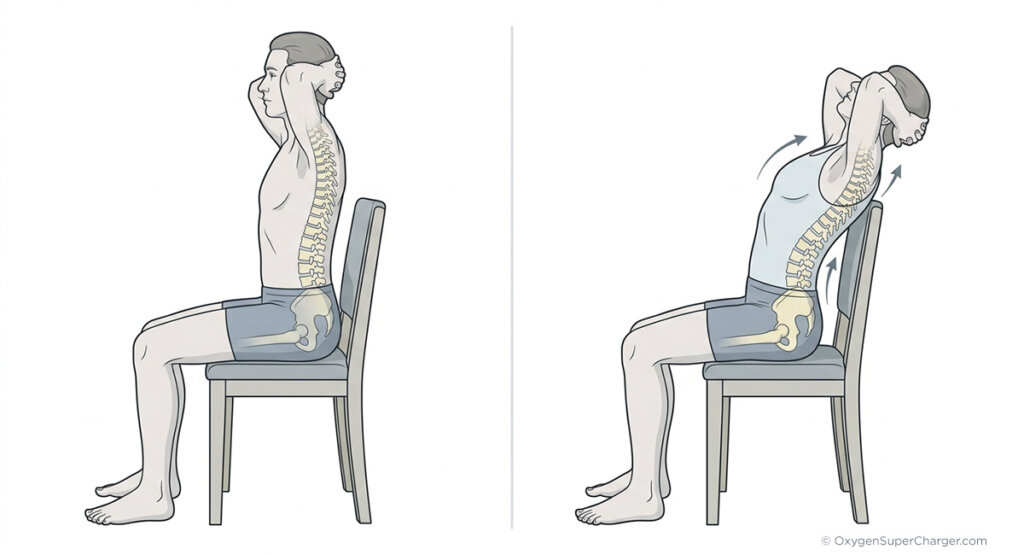
Neither technique requires equipment or special training. Used consistently alongside diaphragmatic breathing, they allow the respiratory system to operate closer to its anatomical potential.
Also Consider
If you are looking for additional support for your body’s oxygen levels, OxygenSuperCharger™ is a bio-available liquid oxygen supplement. It delivers stabilized oxygen directly into the body. Unlike breathing, your current lung capacity does not limit how it is delivered. Similarly, the oxygen content of ambient air is not a factor. OxygenSuperCharger™ provides oxygen in a form that bypasses respiratory function entirely. You can read more about the clinical research supporting ASO® technology on our Research and Studies page.
Nothing on this site is medical advice. If you have a respiratory condition or other health concern, consult a qualified medical professional before beginning any new exercise or breathing program.
References
- Kannel WB, Hubert H, Lew EA. “Vital capacity as a predictor of cardiovascular disease: the Framingham Study.” American Heart Journal. 1983. PubMed. https://pubmed.ncbi.nlm.nih.gov/6823813/
- Ramadan MS, et al. “Reduced total lung capacity is associated with increased cardiovascular risk.” Respiratory Research. 2026. PMC. https://www.ncbi.nlm.nih.gov/pmc/articles/PMC12888710/
- Abudiab M, et al. “FEV1 and total cardiovascular mortality and morbidity: 18-year follow-up EPIC-Norfolk Study.” BMC Public Health. 2019. PMC. https://pmc.ncbi.nlm.nih.gov/articles/PMC6500069/
- Schünemann HJ, Dorn J, Grant BJ, et al. “Pulmonary function is a long-term predictor of mortality in the general population: 29-year follow-up of the Buffalo Health Study.” Chest. 2000;118:656–664.
- Hancox RJ, et al. “Aerobic fitness and lung function: longitudinal associations from childhood to adulthood.” PLOS ONE. 2018. PubMed. https://pubmed.ncbi.nlm.nih.gov/29386347/
- Fernandes M, Cukier A, Feltrim MIZ. “Efficacy of diaphragmatic breathing in patients with COPD.” Chronic Respiratory Disease. 2011. PubMed. https://pubmed.ncbi.nlm.nih.gov/22094449/
- Barbeito-González A, et al. “Controlled diaphragmatic breathing increases hypoxia tolerance and oxygen saturation.” Frontiers in Physiology. 2023. PMC. https://www.ncbi.nlm.nih.gov/pmc/articles/PMC10049086/
- “Pursed Lip Breathing.” StatPearls. NIH/NCBI. https://www.ncbi.nlm.nih.gov/books/NBK545289/
- Wanke T, et al. “Effect of aerobic exercise on FEV1 in young adults.” PubMed. 2013. https://pubmed.ncbi.nlm.nih.gov/23914626/
- Puhan MA, et al. “Aerobic exercise training and lung function: systematic review and meta-analysis.” PubMed. 2020. https://pubmed.ncbi.nlm.nih.gov/33145051/
- Aloraini SM, et al. “Forward head posture and its effect on respiratory function: systematic review.” Bulletin of Faculty of Physical Therapy. 2024. https://bfpt.springeropen.com/articles/10.1186/s43161-024-00186-7
- Malhotra D, et al. “Forward head posture in computer workers and its effect on lung function.” ResearchGate. 2023. https://www.researchgate.net/publication/370288001
-
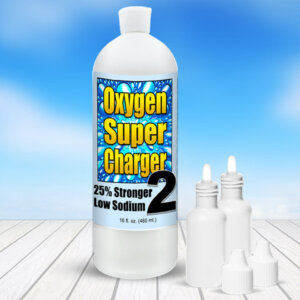
Ultra Strength OxygenSuperCharger2, 25% Stronger, 16–Ounce Bottle
$119.97 Add to cart -

Ultra Strength OxygenSuperCharger2, 25% Stronger, 2–Ounce (Sample Size)
$35.97 Add to cart -

Original 35% Strength OxygenSuperCharger, 16–Ounce Bottle
$96.97 Add to cart -

Original 35% Strength OxygenSuperCharger, 2–Ounce (Sample Size)
$27.97 Add to cart -

MineralSuperCharger, Premium Multi-Mineral Supplement, 32-Ounce Quart
$98.97 Add to cart -

MineralSuperCharger, Premium Multi-Mineral Supplement, 8-Ounce (Sample Size)
$29.97 Add to cart -

Zinc – Plant-Sourced Mineral Concentrate, 16-ounce
$24.97 Add to cart -

O4 Nasal Spray with Zinc
$14.97 Add to cart