The Remarkable Uses of Oxygen That Power Our World

Most people know oxygen keeps them alive. Fewer realize it also shapes modern industry. It’s in the steel in our car and the antifreeze in our engine. It’s also in the beer in our glass and the rocket that carries a satellite into orbit. Oxygen is behind all of it. Oxygen is the most industrially essential element on the planet. Understanding its uses across industry reveals something important about why the body’s own oxygen supply matters so much. The uses of oxygen span twelve major categories, roughly ordered by global consumption volume. From the furnaces that shape civilization to the mitochondria that power every cell you have.
The Production of Industrial Oxygen
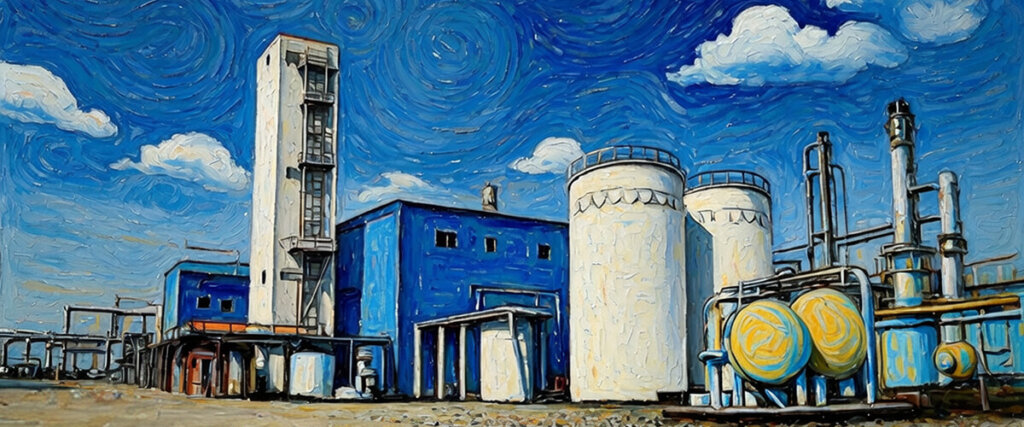
Before oxygen can power a furnace, a refinery, or a rocket, it must be separated from the air we breathe. Air is a mixture — roughly 78% nitrogen, 21% oxygen, and trace amounts of argon and other gases. Pulling oxygen out at industrial scale is a significant engineering challenge. Two main methods account for most of the world’s production.
The dominant process is cryogenic air separation. Large compressors chill air to around -183°C (-297°F) — cold enough to liquefy it. Nitrogen and oxygen liquefy at slightly different temperatures. This means they separate naturally when the liquid air is distilled. Nitrogen boils off first, leaving purified oxygen behind.1 The process takes place in a very tall tower — sometimes several stories high. Oxygen sinks to the bottom and is extracted at purities of 99% or higher. A single large air separation plant can produce thousands of tons of oxygen per day. It consumes around 50 megawatts of electricity to do it — roughly equivalent to powering 40,000 homes every day.1
For smaller operations that need on-site oxygen rather than delivery by tanker, pressure swing adsorption (PSA) is the practical alternative. PSA systems push air through pressurized beds of zeolite — a mineral that selectively traps nitrogen while letting oxygen pass through. When the pressure is reduced, the zeolite releases the trapped nitrogen and regenerates, ready for the next cycle. PSA is faster, cheaper, and far more compact than cryogenic separation. However, it tops out at around 93–95% oxygen purity.2
Global production of industrial oxygen exceeds 500 million tons per year.3 The industries that consume it — from steelmakers to hospitals — depend on this massive but rarely thought-about industry. It runs continuously, around the clock, worldwide.

1. Steelmaking and Metallurgy
The steel industry is the largest single industrial consumer of oxygen in the world. It consumes an estimated 35–50% of all purified oxygen produced globally.4
Modern steelmaking relies on a process called the basic oxygen furnace (BOF). Pure oxygen is blown at high pressure through molten iron. The oxygen reacts with impurities — carbon, silicon, phosphorus — generating enough heat to keep the molten iron at the necessary temperature. The result is cleaner, stronger steel in a fraction of the time required by older methods.4 Oxygen also enriches blast furnaces, increases combustion temperatures in electric arc furnaces, and increases the overall volume of steel produced.5
Air is 78% nitrogen. Furnaces that use air rather than pure oxygen must heat, compress, and exhaust the nitrogen gas — which does nothing useful. Switching to pure oxygen eliminates that waste — less energy consumed, less gas vented.4
According to Britannica, every ton of steel consumes around 110 cubic meters (3,885 cubic feet) of oxygen.6 That’s enough to fill a two-car garage nearly floor to ceiling. Nearly all structural steel in modern buildings, bridges, vehicles, and infrastructure was shaped using industrial oxygen.

2. Chemical and Plastic Synthesis
Some of the most common materials in everyday life exist because of oxygen-driven chemistry. This category ranks second globally in oxygen consumption, at an estimated 15–20% of the world’s purified oxygen supply.7
Automotive antifreeze and polyester fiber — found in clothing, carpet, and plastic bottles — trace back to a compound called ethylene glycol. Ethylene glycol is made from ethylene oxide. Ethylene oxide is produced when ethylene reacts directly with oxygen.8 North America alone produces more than 4.6 million metric tons of ethylene oxide annually.9
Industrial solvents and surfactants such as methanol, propylene oxide, and acrylic acid also depend on oxygen for their production. Methanol is the building block for formaldehyde, which goes into the adhesives that hold plywood, furniture, and cabinetry together. Propylene oxide is used to make polyurethane foam in mattresses, car seats, and building insulation. Acrylic acid is used to make superabsorbent polymers in diapers and hygiene products. In each case, oxygen acts as the oxidizing agent — breaking chemical bonds and rebuilding them into more useful forms.
3. Petroleum Refining and Coal Gasification
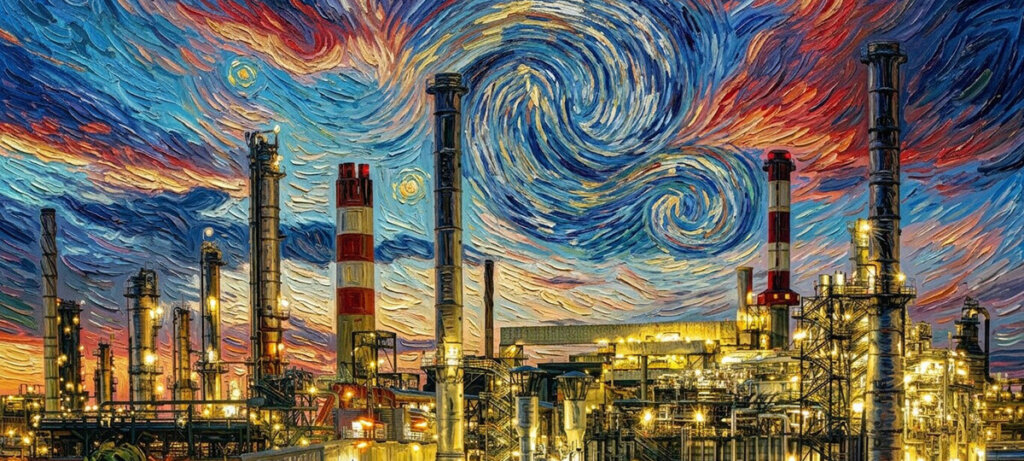
Petroleum refining accounts for an estimated 5–8% of global industrial oxygen consumption.7 Oxygen plays a critical role in converting crude oil into gasoline, diesel, and jet fuel.
The key process is fluid catalytic cracking (FCC). It is the refinery’s primary method for converting heavy, hard-to-use components of crude oil into lighter, more useful fuels. It does this using a catalyst — a substance that accelerates chemical reactions. Coke deposits inevitably build up on the catalyst during the process. Oxygen burns off those deposits, restoring the catalyst’s activity and generating heat that powers other parts of the refinery.10 A typical FCC unit generates 70–80% of its own energy requirement through this oxygen-driven regeneration process.10
Coal gasification uses oxygen to partially combust coal, producing synthesis gas — a mixture of hydrogen and carbon monoxide. This gas can generate electricity or produce chemicals more cleanly than burning coal directly. Using pure oxygen instead of regular air produces a richer, more energy-dense gas. It also makes it easier to capture carbon dioxide and is more environmentally friendly.

4. Metal Fabrication and Welding
Welding and cutting, fueled by oxygen, account for an estimated 3–5% of global oxygen consumption. They are among the oldest and most widely used applications of industrial oxygen.7 Oxygen combined with a fuel gas — typically acetylene — creates a flame that reaches over 3,316°C (6,000°F).7 That is hot enough to melt and permanently join steel, and cut through thick metal plates.
The oxygen serves two roles in oxy-fuel processes. First, it supports the high-temperature flame. Second, it reacts with the carbon in the metal during thermal cutting, generating additional heat that sustains the cut.5 The result is a cleaner burn and less contamination in the weld joint. Bonds are stronger and more reliable than those formed by welding with air alone.7
Plasma cutting also uses oxygen — a jet blows the molten metal from the cut. In laser cutting, a stream of oxygen directed at the cut speeds the process and improves edge quality.5
Thermal lancing uses oxygen to drill through concrete, brick, stone, and heat-resistant metals. It is used in construction and demolition — where nothing but oxygen comes close to achieving the same result.

5. Water and Wastewater Treatment
Municipal wastewater contains organic material that must be broken down before treated water can safely return to rivers, lakes, and aquifers. The microorganisms that perform this breakdown — aerobic bacteria — require dissolved oxygen to function.11 Wastewater treatment accounts for an estimated 2–4% of global industrial oxygen consumption.7
In wastewater treatment plants, oxygen is pumped into large aeration tanks, where it sustains the bacterial communities that digest organic waste. Without adequate dissolved oxygen, aerobic digestion stalls and treatment efficiency collapses — along with downstream water quality.
Industrial oxygen is increasingly used in treatment plants in place of air, because it delivers higher concentrations of dissolved oxygen more efficiently, allowing plants to process more wastewater in less time and in less physical space.11 The same principle applies to contaminated groundwater, where injected oxygen feeds the bacteria that break down petroleum and chemical spills underground.
6. Glass and Ceramics Manufacturing
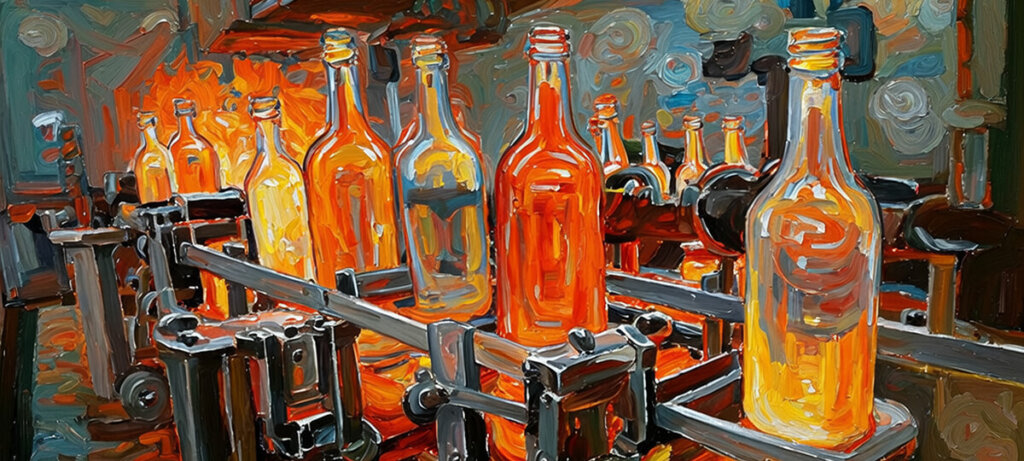
Glass melting requires extreme temperatures — typically between 1,400°C and 1,600°C (2,550°F–2,912°F). Achieving those temperatures efficiently requires oxy-fuel burners, which replace air with oxygen in the flame and dramatically increase combustion intensity.7 Glass and ceramics together represent an estimated 2–3% of global industrial oxygen use.7
Ceramics manufacturing benefits from the same oxygen-enhanced combustion principles, where high-temperature kilns fire everything from floor tiles to industrial components.
Fiberglass production — used in insulation, boat hulls, wind turbine blades, and composite materials — also depends on oxygen-enriched combustion to achieve the consistent, high-temperature melt required for fiber formation.
7. Pulp and Paper Bleaching
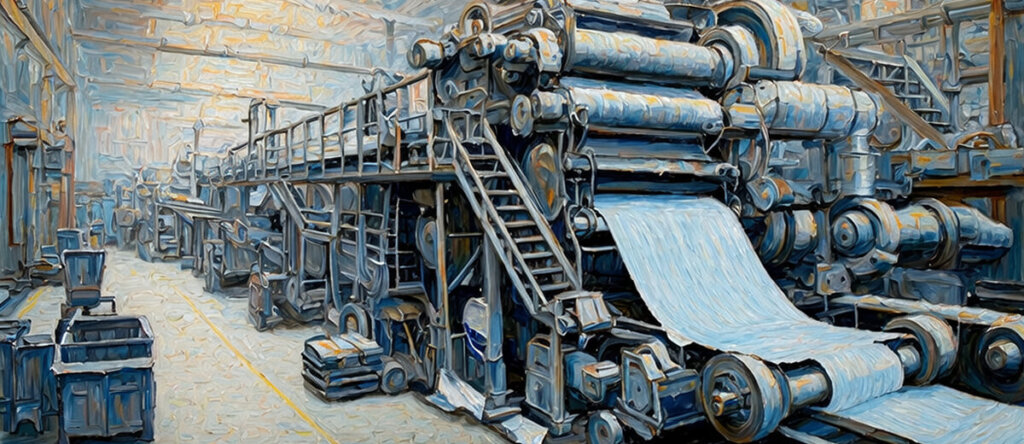
The paper in a book, an envelope, or a coffee cup is white because oxygen helped make it that way. Pulp and paper bleaching accounts for an estimated 1–2% of global industrial oxygen consumption — and oxygen has largely replaced chlorine as the bleaching agent of choice.12
Raw wood pulp contains lignin — the structural polymer that gives wood its rigidity and its brown color. To produce bright, white paper, that lignin must be removed. Oxygen delignification works by targeting lignin specifically — breaking it down and dissolving it while leaving the cellulose fibers that give paper its strength largely intact.12
The environmental case for oxygen bleaching is compelling. Chlorine bleaching generates toxic chlorinated compounds in the wastewater discharged from the mill — including dioxins linked to cancer and hormonal disruption — that are difficult and expensive to treat. Oxygen has reduced overall bleaching chemical costs and has become a recognized strategic technology in modern mill operations.13

8. Commercial Aquaculture
Fish and other aquatic organisms breathe dissolved oxygen. When oxygen levels in a pond or tank drop below critical thresholds, fish become stressed, stop feeding, and die. Commercial aquaculture — the farming of fish, shrimp, and shellfish — depends on active oxygenation to maintain dissolved oxygen levels that sustain healthy populations at densities far above what natural bodies of water could support.14
Aeration systems range from paddle-wheel aerators that splash water across the surface to submerged diffusers that inject oxygen or air directly into the water. Pure oxygen, rather than air, achieves supersaturation — oxygen levels well above what the water would naturally hold — thereby supporting more fish, shrimp, and shellfish, as well as faster growth rates.14
The Food and Agriculture Organization of the United Nations identifies dissolved oxygen as the single most critical water quality variable in fish pond management.14 That is a statement about priorities: before feed, before temperature, before any other factor, oxygen comes first.

9. Food and Beverage Production
Oxygen plays a dual role in food and beverage production. Sometimes its presence is essential — and sometimes its absence is what matters.
In brewing and winemaking, yeast requires dissolved oxygen in the first 12–24 hours of fermentation to build the strong cell membranes needed for healthy sugar conversion and consistent results.15 Without that early oxygen supply, fermentation stalls or produces off-flavors.
On the packaging side, oxygen is a central tool in modified atmosphere packaging (MAP) — a preservation method used across the meat, produce, and ready-to-eat food industries. MAP works by replacing the air inside a food package with a precisely controlled gas mixture. For fresh red meat, high-oxygen MAP maintains the bright red color consumers associate with freshness, while carbon dioxide inhibits bacterial growth, extending refrigerated shelf life from 2–4 days to 10–14 days.16 For other products, oxygen levels are reduced rather than increased, slowing the oxidation and microbial activity that cause food to spoil.
Food and beverage is currently one of the fastest-growing segments of industrial oxygen demand, projected to grow at 9.06% annually through 2035, driven by increasing use of oxygen in packaging, preservation, and processing.17

10. Photodynamic Therapy
One of the most forward-looking uses of oxygen in medicine is photodynamic therapy (PDT) — a non-invasive cancer treatment that uses oxygen’s chemistry to destroy tumor cells.
PDT works by combining three elements: a photosensitizing agent delivered to tumor tissue, a specific wavelength of light directed at the tumor, and oxygen present in the tissue. When the photosensitizer activates, it transfers energy to molecular oxygen, generating singlet oxygen — a highly reactive form of O₂ that attacks and destroys surrounding tumor cells.18 — the NIH’s biomedical research archive — described PDT as a non-ionizing treatment that produces direct tumor cell death, damages the blood vessels supplying the tumor, and induces a local inflammatory response that activates immune activity against cancer cells.18 It has treated lung, esophageal, bladder, and skin cancers, and research continues to expand its applications.
PDT works precisely because oxygen is selectively reactive under the right conditions — a property that mirrors why oxygen is so remarkable in biology and industry. It is reactive enough to power combustion, metabolize food into energy, and destroy tumor cells. And yet the body, under normal conditions, manages it with extraordinary precision — using it exactly where it is needed and no more.

11. Rocket Propulsion
Rocket propulsion represents less than 0.5% of global oxygen consumption by volume — but it may be the most dramatic of all uses of oxygen ever devised.7
Combustion requires oxygen. In Earth’s atmosphere, rockets can draw on atmospheric oxygen during lower-altitude flight — but space has none. To burn fuel above the atmosphere, rockets carry their own oxygen in liquid form.
Liquid oxygen, abbreviated as LOX, is a pale cyan colored, strongly magnetic liquid stored at -183°C (-297°F).19 Robert H. Goddard used it as the oxidizer in the first liquid-fueled rocket in 1926, and it remains the oxidizer of choice for modern spaceflight.19 The Space Shuttle’s main engines ran on LOX and liquid hydrogen. The Saturn V that carried Apollo astronauts to the moon used LOX in every stage. Today, LOX powers SpaceX’s Falcon 9 (paired with RP-1 kerosene) and NASA’s Space Launch System (paired with liquid hydrogen).20
LOX is not merely one option among many — it is the standard against which other oxidizers are measured. The combination of LOX and liquid hydrogen produces the most efficient thrust of any commonly used chemical propellant, meaning more thrust per unit of fuel consumed.20 That efficiency is why it remains dominant despite the difficulty of storing it at very low temperatures.
12. Medical Life Support
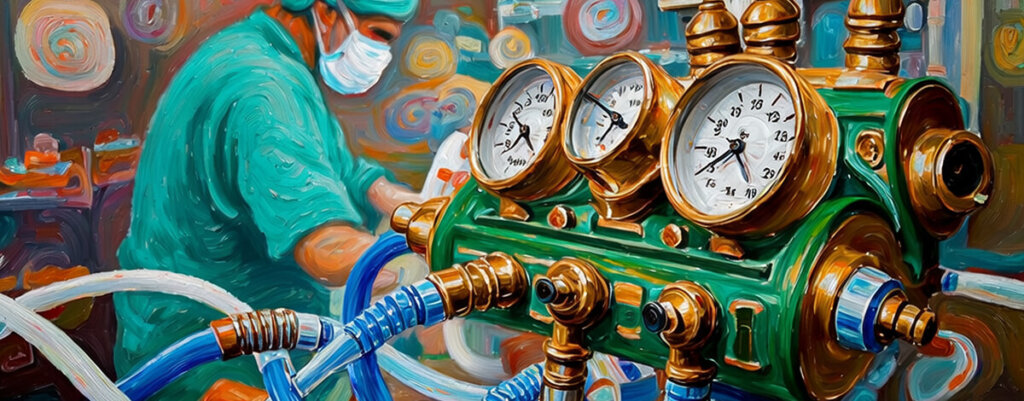
In hospitals, oxygen is not a supplement — it is a prescribed drug. According to StatPearls at the National Institutes of Health, oxygen is a critical component of emergency medicine and critical care. Its absence leads to hypoxia, multisystem dysfunction, hypoxic brain injury, and cardiac arrest.21
A 2021 PMC review noted that medical oxygen is recognized by the World Health Organization as an essential medicine — a designation that reflects its irreplaceable role across surgical, emergency, and critical care settings.22 Oxygen is also central to anesthesia, open-heart surgery, and neonatal care. Without a reliable oxygen supply, hospitals cannot function.
Medical oxygen represents an estimated 6–12% of global industrial oxygen consumption by volume — a surprisingly modest share given how essential it is to human life.7 The reason is scale: industrial processes consume oxygen by the millions of tons, while hospitals measure it in liters per minute. But no use of oxygen carries higher stakes.
The body’s need for oxygen does not begin in the hospital. It begins with the continuous demand for oxygen by every cell, tissue, and organ in your body. The medical applications of oxygen are simply the most visible expression of an ever-present need.
The Application That Matters Most
Every use of oxygen on this list — the furnace, the refinery, the treatment plant, the cancer clinic, the rocket — reflects the same underlying chemistry. Oxygen reacts. It transfers energy. It makes things possible that would otherwise be impossible or impossibly slow.
The human body runs on the same principle. Every cell requires a continuous supply of oxygen to produce ATP — the energy molecule that powers muscle contraction, nerve signaling, immune response, and cellular repair. The mitochondria in your cells perform a version of the same combustion that powers a rocket engine, only with glucose as the fuel and at a scale measured in micrometers.
The steel industry invests heavily in optimizing its oxygen supply because the payoff is measurable and significant — more output, less waste, greater efficiency. Your body responds the same way. When cells have the oxygen they need, energy production runs at full capacity, recovery is faster, cognitive clarity improves, and immune response stays strong.
Oxygen is not a passive background element. It is the active driver of energy production in every living system. The industries that have built civilization around oxygen have simply made visible what every living thing has always depended on.
Also Consider
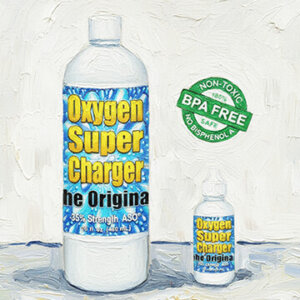
If you are looking for additional support for your body’s oxygen levels, OxygenSuperCharger™ is a bio-available liquid oxygen supplement that provides stabilized oxygen directly to the body. You can read more about the clinical research supporting ASO® technology on our Research and Studies page.

-
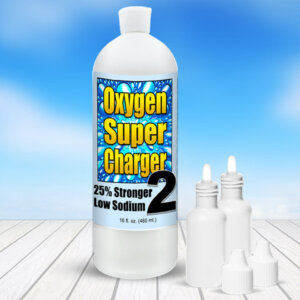
Ultra Strength OxygenSuperCharger2, 25% Stronger, 16–Ounce Bottle
$119.97 Add to cart -
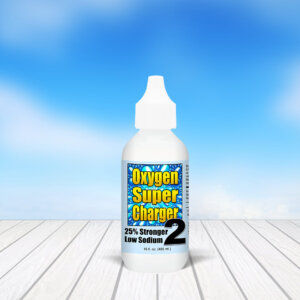
Ultra Strength OxygenSuperCharger2, 25% Stronger, 2–Ounce (Sample Size)
$35.97 Add to cart -
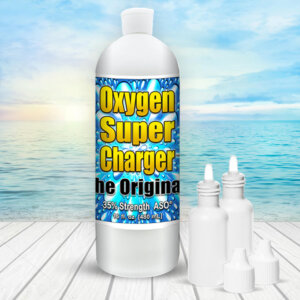
Original 35% Strength OxygenSuperCharger, 16–Ounce Bottle
$96.97 Add to cart -
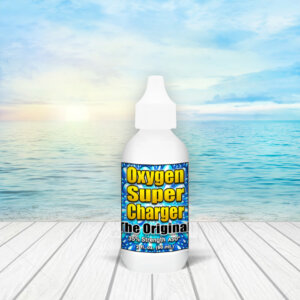
Original 35% Strength OxygenSuperCharger, 2–Ounce (Sample Size)
$27.97 Add to cart -

MineralSuperCharger, Premium Multi-Mineral Supplement, 32-Ounce Quart
$98.97 Add to cart -

MineralSuperCharger, Premium Multi-Mineral Supplement, 8-Ounce (Sample Size)
$29.97 Add to cart -

Zinc – Plant-Sourced Mineral Concentrate, 16-ounce
$24.97 Add to cart -

O4 Nasal Spray with Zinc
$14.97 Add to cart