250 Years in the Making: The Story of Stabilized Oxygen

Oxygen has kept life on Earth alive for billions of years. But humans only discovered it 250 years ago. It took another two centuries before anyone figured out how to stabilize it in a bottle. The history of stabilized oxygen starts long before anyone thought about supplements.
It is really two stories in parallel. The first is scientific: the discovery of oxygen, how it got its name, and how medicine put it to use. The second is an engineering story: how researchers learned to liberate oxygen from water and hold it stable — in a form the body can absorb. OxygenSuperCharger™ is the current chapter of the second story. To fully trace the history of stabilized oxygen, it helps to go back to the beginning.
The Discovery Nobody Agreed On
Ask most people who discovered oxygen, and you’ll likely get a blank stare. Someone with a little bit of knowledge on the subject would say Joseph Priestley. Ask a historian of science, and the answer gets more complicated.
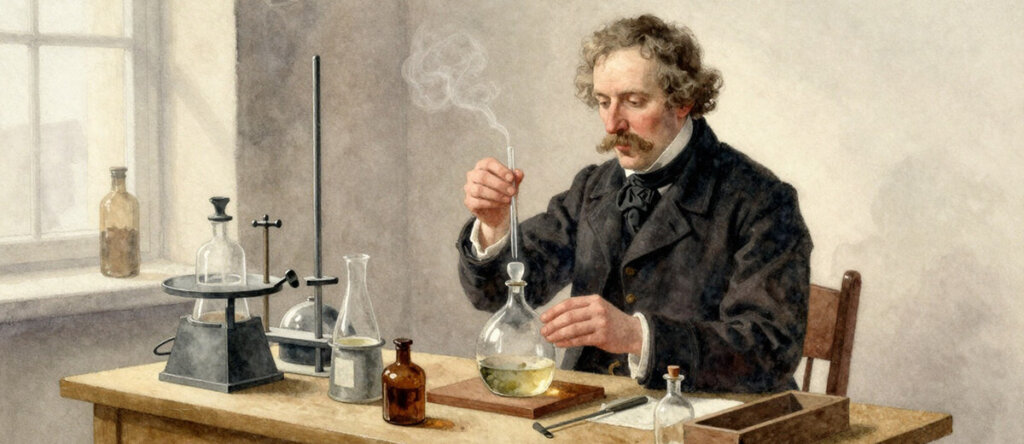
A Swedish pharmacist named Carl Wilhelm Scheele was first. He worked in a modest laboratory with no expensive equipment. Between 1771 and 1772, Scheele heated various compounds — including mercuric oxide and potassium nitrate. The result was a gas that made candles burn with unusual intensity. He called it Feuer Luft, or “fire air.” Experiments confirmed it was the component of air that supported both combustion and breathing.1
Scheele knew the significance of what he had found. He sent his manuscript to the printer in 1775. Publishing delays intervened. His book — Chemical Treatise on Air and Fire — did not appear in print until 1777.1
By then, an English clergyman named Joseph Priestley had already published his own account. On August 1, 1774, Priestley focused sunlight through a large lens onto red mercuric oxide and collected the colorless gas that was released. A candle burned vigorously in it. A mouse placed in a sealed container stayed lively far longer than in ordinary air.2 At the time, the reigning theory of combustion held that burning objects released a substance called phlogiston. Priestley called it “dephlogisticated air” — air stripped of phlogiston, leaving it unusually pure and capable of supporting combustion with great intensity.
Priestley published first, so he received the credit. Scheele, who discovered it first, has largely been a footnote in popular history ever since.
Lavoisier Changed Everything
A third figure then entered the picture and changed everything. French chemist Antoine-Laurent Lavoisier repeated Priestley’s experiment and recognized that a new element was involved. He set about demolishing the phlogiston theory that had obscured what both Scheele and Priestley had found. Lavoisier understood that combustion did not release a substance — it consumed one. That substance was the gas both Scheele and Priestley had independently discovered.3
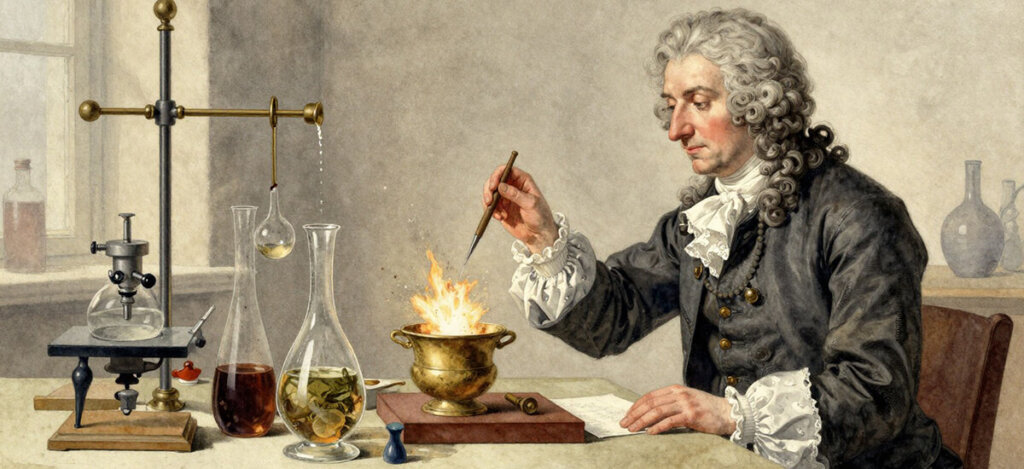
In 1778, Lavoisier gave it the name we still use today: oxygen. He coined the word from the Greek oxys (sharp or acid) and genes (producer). He believed oxygen was a necessary component of all acids — but he was wrong. Humphry Davy later showed that Lavoisier was wrong by proving that hydrochloric acid contains no oxygen. Unfortunately, the name stuck anyway.3 Every time someone says “oxygen,” they unknowingly repeat an 18th-century chemistry error.
Lavoisier’s real contribution was not the name but the framework. By correctly describing oxygen’s role in combustion and respiration, he demolished the phlogiston theory and laid the foundation for modern chemistry. That framework shaped everything that followed, including the history of oxygen therapy.
From Laboratory Curiosity to Medical Tool
The leap from scientific discovery to medical use was not immediate. Early experiments with oxygen as a therapy were enthusiastic but inconsistent.
In 1789, the English physician Thomas Beddoes — sometimes called the father of respiratory therapy — opened the Pneumatic Institute in Bristol. He experimented with oxygen and other gases as treatments for asthma and heart failure. His collaborator on the equipment was inventor James Watt. The Institute eventually closed. Apothecaries continued to offer oxygen through the 18th and early 19th centuries. Widespread use, however, remained out of reach.4
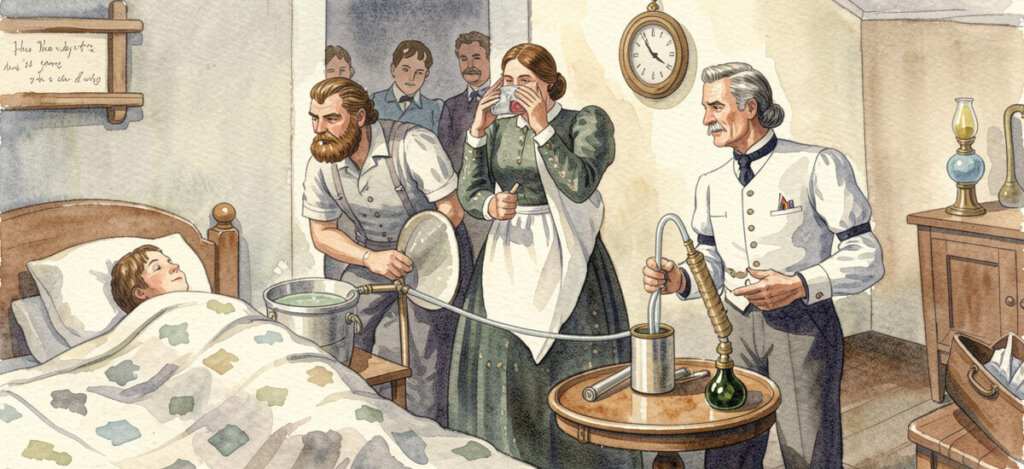
The problem was not the idea. It was the engineering. Before 1868, there was no practical way to store oxygen. Patients could inhale it in a clinical setting, but transporting it was not feasible. The compressed oxygen cylinder changed that. By the 1890s, hospitals could pipe oxygen directly into patient rooms.4
Still, the medical community remained skeptical. Results were inconsistent, costs were high, and delivery methods were crude. Only when nasal catheters and oxygen masks arrived in the early 1900s did oxygen therapy become more reliably effective.4
Progress continued through the 20th century. In the 1920s, Leonard Hill invented the oxygen tent, later refined by the American physician Alvan Barach. Barach went on to design the first portable oxygen device for emphysema patients in 1936.4
World War II considerably accelerated the development of portable oxygen equipment. Military medicine needed solutions that worked not just in hospitals, but in the field. Those devices became the foundation for post-war medical oxygen delivery.5 By the 1950s, oxygen appeared in ambulances and homes and was being prescribed for COPD.
The Problem with Putting Oxygen in a Bottle
Up until now, all medical oxygen was inhaled. Compressing oxygen into a pressurized container was the only delivery method available to anyone.
The difficulty with turning oxygen into a liquid supplement is that oxygen molecules are inherently unstable. Oxygen molecules are “restless” — they are eager to react with other substances — which is exactly what drives cellular respiration. When oxygen reacts with glucose in your cells, it releases the energy that powers everything your body does. It’s the same chemistry as combustion, just controlled and slow. Without that reactivity, oxygen couldn’t do its job. That restlessness is what makes oxygen essential to life — and what makes it hard to store.
Standard oxygen gas does not simply dissolve in water and stay there. Dissolved gas doesn’t form bubbles in water — it exists as individual molecules trapped in the spaces between water molecules. Two conditions determine how much gas water can hold: temperature and pressure. Colder water holds more dissolved gas; heat drives it out. Higher pressure forces more gas into solution; when pressure drops — like opening a soda can — the gas escapes as bubbles. The moment a bottle opens, the gas escapes. Anyone who has opened a can of soda pop has seen this in action: dissolved gas escapes the moment pressure drops. The same principle applies to products marketed as oxygenated water.6

For a liquid supplement to deliver oxygen to the body’s cells, the oxygen needs to survive in the liquid long enough to be absorbed into the bloodstream. That means the liquid must hold the oxygen in some sort of stable form — not as dissolved gas.
That was the engineering challenge. The answer required creating something entirely new.
From Chlorite to Tetraoxygen: The Engineering of Stabilized Oxygen
The first generation of stabilized oxygen supplements appeared in the 1980s and 90s. They used sodium chlorite (ClO₂⁻) — two oxygen atoms bonded to a single chlorine molecule. The concept was sound: hold oxygen in a stable ionic form rather than as dissolved gas. But these early products had a major drawback… They were extremely alkaline, with pH levels of 12 or higher, making them potentially caustic. They could burn the skin and tissues of the mouth and esophagus.7
A better solution would require an entirely different approach. The goal was a concentrated, bio-available (readily absorbed by the body) liquid oxygen supplement — stable, effective, and safe — with a neutral pH that would not harm the body’s tissues.
The Breakthrough
In 1984, Oxigenesis began R&D on a new formulation for the wastewater treatment industry. The result was the world’s first pH-balanced stabilized oxygen solution, at 3% strength. The new process produced polyatomic tetraoxygen, or O₄ — a cluster of four oxygen atoms — rather than the sodium chlorite used in earlier products.8
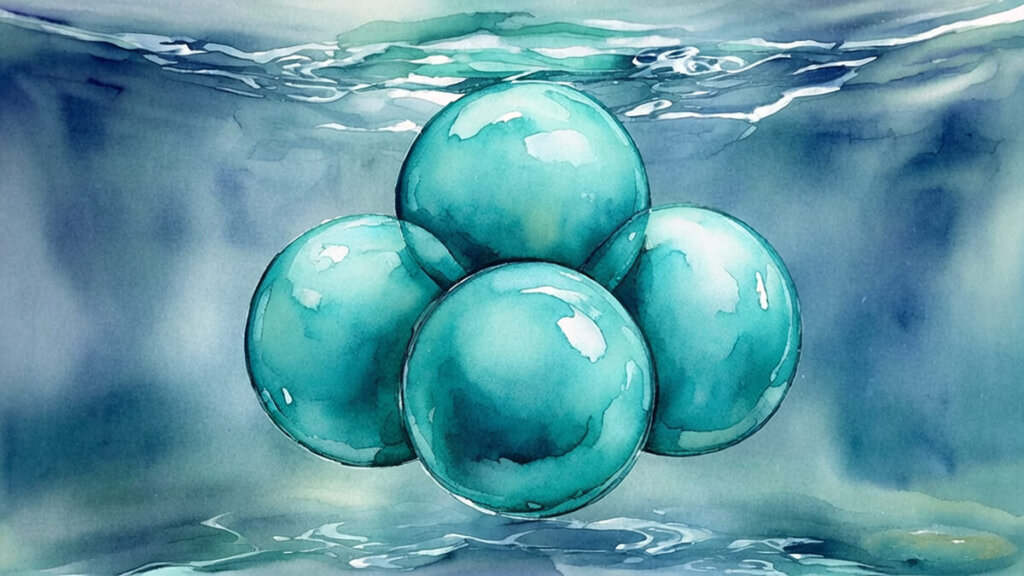
Standard oxygen (O₂) is diatomic — two oxygen atoms bonded together. O₄ is different. The bonds between all four oxygen atoms are very strong. O₄ remains intact in liquid solution rather than escaping into the air as a gas. O₄ was theorized as early as 1924. It was not confirmed until the 1990s and 2000s, when mass spectrometry became available.9 As an oxidizer, O₄ is completely non-toxic and is more powerful than either O₂ or ozone.
Over the following years, Oxigenesis continued refining the process. By 1989, the concentration had reached 5%, and the product was first released for consumer use. Then, in 1996, it had reached 25%, and Oxigenesis released it for therapeutic and sports-nutrition applications. By 2004, it reached 35% — 350,000 parts per million of bio-available O₄.9 The most recent advance came when Oxigenesis replaced the sea salt base with a proprietary blend of minerals. That reformulation produced OxygenSuperCharger2™ — an Ultra Strength formula 25% more concentrated than the already-potent 35% original.
What Stabilized Oxygen Is Not
The stabilized oxygen process differs from recent photocatalytic water-splitting research, which uses sunlight and catalysts such as cobalt oxide nanoparticles to produce hydrogen as a clean fuel source.10 That research aims to eliminate oxygen from water and collect the hydrogen. Stabilized oxygen technology holds and delivers the oxygen.
Stabilized Oxygen and OxygenSuperCharger™
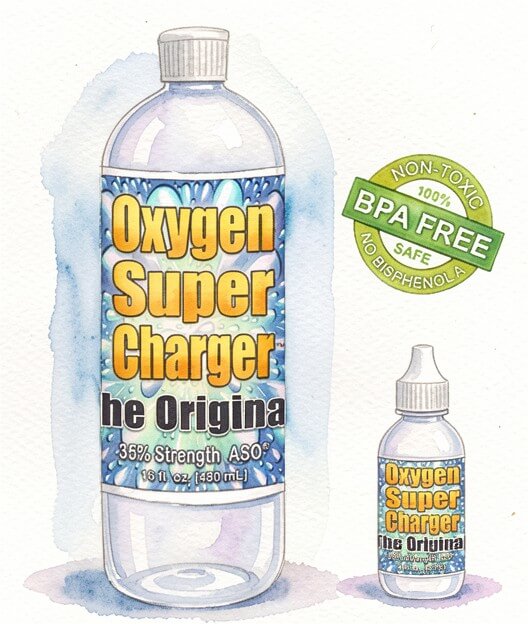
The stabilized oxygen technology developed by Oxigenesis has been the subject of more than two dozen independent studies examining its safety and efficacy since its release.9 No contraindications have been recorded — meaning no known interactions with medications or conditions that would make it unsafe to take. Independent toxicity testing has confirmed it is non-toxic at full strength.
OxygenSuperCharger™ is built on that same technology, which took over a million dollars to develop and perfect.11
Three clinical studies have been conducted on the specific formula used in OxygenSuperCharger™. The Bio-Available Liquid Oxygen page covers those studies in detail, including an honest account of their limitations. The most notable finding comes from a 2017 study in the Journal of the International Society of Sports Nutrition. It found that the oxygen supplement enhanced lactate clearance in trained runners — a meaningful result for athletic recovery.11
Two Centuries, One Bottle
The line from Scheele’s laboratory in 1772 to a bottle of OxygenSuperCharger™ is not a straight one. It runs through an English garden where Priestley focused sunlight on red powder. It passes through Lavoisier’s scales, oxygen tents, and military field hospitals. And it winds through decades of industrial chemistry research that nobody originally intended for human supplementation.
What connects all of it is a persistent recognition at the heart of the history of stabilized oxygen: oxygen is not just something we breathe in passing. It is the engine that drives every cell in the body. The history of stabilized oxygen is, at its core, the history of trying to make more oxygen available to more people in more forms.
That work is still ongoing. The science continues to develop. And when the supplement is sitting on your shelf, you’ll know it was 250 years in the making.
References
- New World Encyclopedia. Carl Wilhelm Scheele.” https://www.newworldencyclopedia.org/entry/Carl_Wilhelm_Scheele
- West JB. Joseph Priestley, oxygen, and the Enlightenment.” American Journal of Physiology-Lung Cellular and Molecular Physiology. 014. ttps://journals.physiology.org/doi/full/10.1152/ajplung.00310.2013
- Etymology Online. Oxygen.” https://www.etymonline.com/word/oxygen
- CalOx Inc. “A Brief History of Oxygen in Medicine.” https://caloxinc.com/blog/a-brief-history-of-oxygen-in-medicine/
- Inogen. History of Oxygen Concentrators & Oxygen Therapy.” https://www.inogen.com/resources/oxygen-concentrators/history-of-oxygen-concentrators/
- Tang X, et al. “Electrolysis of water is an effective source of oxygen at high altitude.” Journal of Translational Medicine. 022. PMC9134583. https://www.ncbi.nlm.nih.gov/pmc/articles/PMC9134583/
- Oxigenesis, LLC. Oxygen • The Story.” Internal product document. Paso Robles, CA. Copyright 2014.
- Oxigenesis, LLC. About Oxigenesis.” Company history and product development timeline. opyright 2015.
- Oxigenesis, Inc. “About ASO®.” Internal product document. February 6, 2023.
- NIH/PMC. Efficient solar water splitting using a nanocrystalline CoO photocatalyst.” Referenced in How to Split Water into Hydrogen and Oxygen, OxygenSuperCharger.com.
- Fleming N, Vaughan J, Feeback M. Ingestion of oxygenated water enhances lactate clearance kinetics in trained runners.” Journal of the International Society of Sports Nutrition. 017. PMC5371271. https://www.ncbi.nlm.nih.gov/pmc/articles/PMC5371271/

-
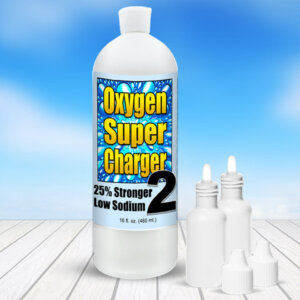
Ultra Strength OxygenSuperCharger2, 25% Stronger, 16–Ounce Bottle
$119.97 Add to cart -
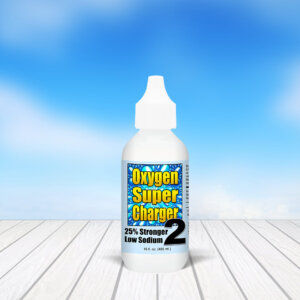
Ultra Strength OxygenSuperCharger2, 25% Stronger, 2–Ounce (Sample Size)
$35.97 Add to cart -
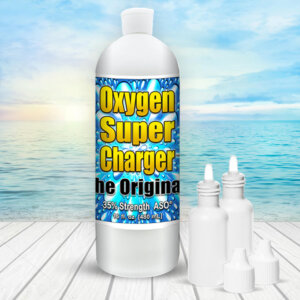
Original 35% Strength OxygenSuperCharger, 16–Ounce Bottle
$96.97 Add to cart -
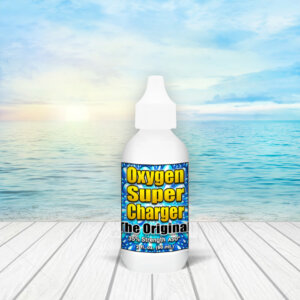
Original 35% Strength OxygenSuperCharger, 2–Ounce (Sample Size)
$27.97 Add to cart -

MineralSuperCharger, Premium Multi-Mineral Supplement, 32-Ounce Quart
$98.97 Add to cart -

MineralSuperCharger, Premium Multi-Mineral Supplement, 8-Ounce (Sample Size)
$29.97 Add to cart -

Zinc – Plant-Sourced Mineral Concentrate, 16-ounce
$24.97 Add to cart -

O4 Nasal Spray with Zinc
$14.97 Add to cart