Free Radicals and Aging: The Surprising Truth

If you have ever taken an antioxidant supplement, you already know the basic story: free radicals damage your cells, antioxidants neutralize free radicals, and that is how you slow down aging. It makes perfect sense — on the surface. But research over the past two decades has complicated that picture — and some of the most surprising findings have come from a University of Michigan lab studying tiny roundworms.
What Are Free Radicals?
Free radicals are unstable molecules with an unpaired electron. Because electrons travel in pairs, free radicals quickly grab onto nearby molecules to steal one. That chain reaction can damage DNA, proteins, and cell membranes — a process called oxidative stress.1
Your body constantly produces free radicals as a byproduct of normal metabolism. Every time your cells turn oxygen and nutrients into energy, the creation of reactive oxygen species (ROS) — the broader family that includes free radicals — is part of the process.2 In addition, pollution, cigarette smoke, radiation, and intense exercise can all make the problem worse.
For decades, the thinking was simple: ROS builds up, damage accumulates, and aging follows. This became known as the free radical theory of aging, first put forward by scientist Denham Harman in 1956.3
The Free Radical Theory — and Where It Gets Complicated
Harman’s theory made good sense, and for decades it drove both research and the supplement market. The logic was hard to argue with: if ROS causes aging, then antioxidants should slow it down.
The problem is that the evidence has not consistently supported that. Studies in animals have found that raising antioxidant enzyme levels does not reliably extend lifespan.4 In some cases, when antioxidant defenses were lowered, the animals lived longer. A 2014 paper in Antioxidants & Redox Signaling by Harvard Medical School researcher Vadim Gladyshev concluded that oxidative damage is just one of many forms of cellular damage that build up over time — and that free radicals alone cannot explain why we age.5
That does not mean antioxidants are useless. It means the story of free radicals and aging is more complicated than it first appeared.

Not All Free Radicals Are the Enemy
Part of what makes this complicated is that ROS is not purely destructive. At moderate levels, they act as chemical signals — messengers that switch on protective and repair processes inside cells.6 For example, your immune system deliberately makes free radicals to kill pathogens. Cells also use ROS to control growth, stress responses, and gene activity.
The key is balance. When ROS production outpaces the body’s ability to manage them, damage accumulates. But at moderate levels, ROS appear to help keep cells alert and resilient.
This matters for how we think about antioxidant supplements. Wiping out all free radicals could interfere with these useful signaling roles — something researchers are still working to understand fully.
The University of Michigan Study: More Early Stress, Longer Life
The most striking evidence yet for the complexity of free radicals and aging came from a 2019 study in Nature by University of Michigan researchers Daphne Bazopoulou and Ursula Jakob.7
The study used C. elegans, a small roundworm that is a workhorse of aging research. These worms are genetically identical in the lab and live only a few weeks — ideal for lifespan experiments. Yet even among worms with the same genes, raised in the same environment, lifespans vary widely. Some die after three days. Others are still moving after twenty.
Jakob and Bazopoulou wanted to know what drove that difference.
What they found flipped the conventional view. During early development — the worm’s version of childhood — individual worms varied widely in how much ROS they produced. The team sorted thousands of larvae by their oxidative stress levels and followed them over their lifetimes.
Worms that had more oxidative stress early in life actually lived longer. When the researchers deliberately exposed an entire population of young worms to additional ROS during development, the group’s average lifespan increased.7
“Experiencing stress at this early point in life may make you better able to fight stress you might encounter later in life,” said Bazopoulou.
How Early Stress Builds Long-Term Resilience
The team found a biological explanation for what they saw. Higher ROS levels during development triggered changes in how DNA is packaged inside the cell — specifically, a drop in the chemical tag H3K4me3, which influences which genes get turned on.7 This shift appeared to set the animals up for better stress resistance throughout their lives.
The longer-lived worms were not better at neutralizing free radicals — their antioxidant enzyme levels were no higher than those of shorter-lived worms. Whatever had changed ran deeper than that. The early oxidative stress seemed to work like a training signal — one that recalibrated the cell’s defenses for the long haul.
An earlier study from the same lab, published in Molecular Cell in 2012, first mapped the surprising pattern of ROS levels across the worm’s lifespan: high during early development, dropping off in adulthood, then rising again in old age.8 That study also found that long-lived worm strains bounced back from early oxidative stress more quickly than short-lived ones — suggesting that how an organism handles early ROS matters as much as how much ROS it produces.
In short, the connection between free radicals and aging is not simply about damage — it is also about how the body learns to respond to stress over time.
What This Means for Understanding Free Radicals and Aging
None of this means oxidative stress is good for you, or that antioxidants have no place. What it does suggest is that the relationship between free radicals and aging cannot be reduced to a simple equation — and that research into free radicals and aging is still uncovering surprises.
Research now points to a model in which timing, dose, and context all matter — and ROS can play both damaging and protective roles, depending on the situation.6 A brief oxidative challenge early in life may activate defenses that pay off for decades. By contrast, chronic, unmanaged oxidative stress is a different matter — it drives the kind of cellular damage associated with aging and age-related decline.
Researchers have also found that mitochondria — the structures that produce most of the body’s ROS as a byproduct of generating energy — sit at the center of cellular aging.9 As we get older, mitochondrial function drops, ROS output climbs, and antioxidant defenses thin out, setting up a cycle that compounds over time.9
The Role of Oxygen in the Free Radical Picture
Oxygen is at the heart of all of this. Free radicals are reactive oxygen species. Oxygen powers aerobic life, and as a byproduct of normal cellular activity, it also produces unstable byproducts or ROS. Aging is, in part, a story about oxygen and what it leaves behind.
Aging accelerates when cells are starved of oxygen. Without enough oxygen, cells shift from efficient aerobic energy production to anaerobic fermentation — compromising the cells’ ability to generate energy and support the cellular defense systems that keep free radicals in check and slow aging.
For a closer look at how oxygen and antioxidants work together at the cellular level, see our video on oxygen, antioxidants, and free radicals.

Supporting Your Body’s Oxygen and Antioxidant Balance
The emerging science of free radicals and aging points toward balance, not elimination. Overall, the goal is not to wipe out every free radical, but to support the body’s own ability to keep oxidative stress in check — which depends on cells having adequate oxygen, healthy mitochondria, and the antioxidant enzymes the body produces naturally.
A diet rich in vegetables, fruits, and whole foods helps the body maintain healthy levels of free radicals. Regular exercise helps too — it briefly raises ROS and also pushes the body to strengthen its own antioxidant defenses.
If you are looking for additional support for your body’s oxygen levels, OxygenSuperCharger™ is a bio-available liquid oxygen supplement that provides stabilized oxygen directly to the body. You can read more about the clinical research supporting ASO® technology on our Research and Studies page.
References
- Lobo V, Patil A, Phatak A, Chandra N. “Free radicals, antioxidants and functional foods: Impact on human health.” Pharmacogn Rev. 2010. PMC. https://www.ncbi.nlm.nih.gov/pmc/articles/PMC3249911/
- Phaniendra A, Jestadi DB, Periyasamy L. “Free Radicals: Properties, Sources, Targets, and Their Implication in Various Diseases.” Indian J Clin Biochem. 2015. PMC. https://www.ncbi.nlm.nih.gov/pmc/articles/PMC4310837/
- Harman D. “Aging: a theory based on free radical and radiation chemistry.” J Gerontol. 1956. PubMed. https://pubmed.ncbi.nlm.nih.gov/13332224/
- Pérez VI, Van Remmen H, et al. “The overexpression of major antioxidant enzymes does not extend the lifespan of mice.” Aging Cell. 2009. PMC. https://www.ncbi.nlm.nih.gov/pmc/articles/PMC2667893/
- Gladyshev VN. “The Free Radical Theory of Aging Is Dead. Long Live the Damage Theory!” Antioxid Redox Signal. 2014. PMC. https://www.ncbi.nlm.nih.gov/pmc/articles/PMC3901353/
- Schieber M, Chandel NS. “ROS Function in Redox Signaling and Oxidative Stress.” Curr Biol. 2014. PMC. https://www.ncbi.nlm.nih.gov/pmc/articles/PMC4055301/
- Bazopoulou D, Knoefler D, Zheng Y, et al. “Developmental ROS individualizes organismal stress resistance and lifespan.” Nature. 2019. PubMed. https://pubmed.ncbi.nlm.nih.gov/31801997/
- Knoefler D, Thamsen M, Koniczek M, et al. “Quantitative in vivo redox sensors uncover oxidative stress as an early event in life.” Mol Cell. 2012. PMC. https://www.ncbi.nlm.nih.gov/pmc/articles/PMC3370649/
- Bratic A, Larsson NG. “The role of mitochondria in aging.” J Clin Invest. 2013. PMC. https://www.ncbi.nlm.nih.gov/pmc/articles/PMC3561755/

-
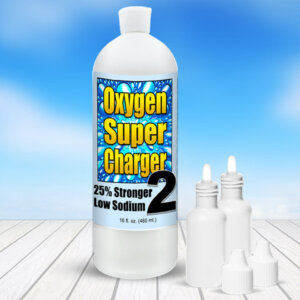
Ultra Strength OxygenSuperCharger2, 25% Stronger, 16–Ounce Bottle
$119.97 Add to cart -
Ultra Strength OxygenSuperCharger2, 25% Stronger, 2–Ounce (Sample Size)
$35.97 Add to cart -
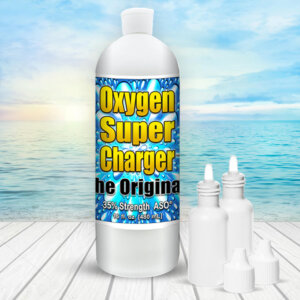
Original 35% Strength OxygenSuperCharger, 16–Ounce Bottle
$96.97 Add to cart -
Original 35% Strength OxygenSuperCharger, 2–Ounce (Sample Size)
$27.97 Add to cart -

MineralSuperCharger, Premium Multi-Mineral Supplement, 32-Ounce Quart
$98.97 Add to cart -
MineralSuperCharger, Premium Multi-Mineral Supplement, 8-Ounce (Sample Size)
$29.97 Add to cart -
Zinc – Plant-Sourced Mineral Concentrate, 16-ounce
$24.97 Add to cart -

O4 Nasal Spray with Zinc
$14.97 Add to cart